
As an unrepentant logophile (lover of words), I’ve assembled a list of unusual, obscure, or simply charming-to-me words. Ludic is defined as “playful, in an aimless way,” and that’s my plan for approaching this a-to-z challenge—keeping my feet on the joy trail and meandering wherever the daily word takes me.
V is for…
vesta – a short wooden match. Etymology: after Vesta, the goddess of hearth and household in Roman mythology. Earliest documented use: 1839
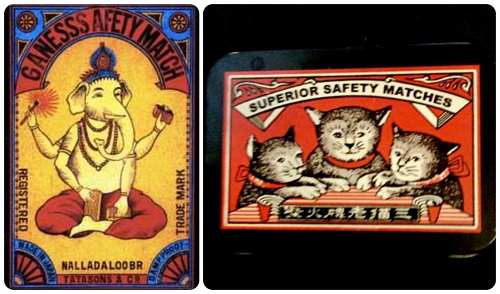
I couldn’t resist starting this musing with these tins printed with vintage matchbox labels. Aren’t they great? The matches are long gone, but I keep tiny treasures in them now.
Vesta is the Roman goddess of hearth, home, and domestic life, and in her Greek iteration she was known as Hestia. The fire of Vesta was considered sacred and kept lit in her temples, maintained by the priestesses of Vesta, known as Vestal Virgins.

The ancient Greeks, for whom Hestia was the precursor to the Roman’s Vesta, had an interesting belief about the source of her fire.
Myth tells us that Zeus declared Delphi to be the center of Earth – its navel. And that by 800 BCE Delphi had been dedicated as a major site of worship for Apollo. We tend to know Delphi as the place where the Oracle was consulted. That’s certainly true, but there is also a deep connection to Hestia.
The source of Hestia’s sacred fire was believed to be the molten core at the center of the Earth, which was connected by an umbilical cord to the omphalos in Delphi.
The omphalos was a stone monument marking the sacred navel point, and it was shaped somewhat like a beehive, and carved with bees. The chief priestess at Delphi, Pythia, served as the Delphic Oracle and was also called the “Delphic Bee.” It has been suggested that Pythia would fall into a trance, while sitting by the omphalos breathing in fumes from the center of Earth and thus be able to deliver her oracular wisdom.
The front columns of the temple were inscribed with 147 maxims said to be given by Apollo. The maxims are short, I think none more than five or six words, and offer guidance for conduct – a compendium of ethical and moral behavior.
One of the maxims is: Honor the hearth (or Hestia) Hestia was thought to reside in the center of all homes, providing the flames which gave light and warmth and allowed food to be cooked, thereby providing sustenance. She was honored as a sustainer of life, family, domesticity, and what turned a house into a home.
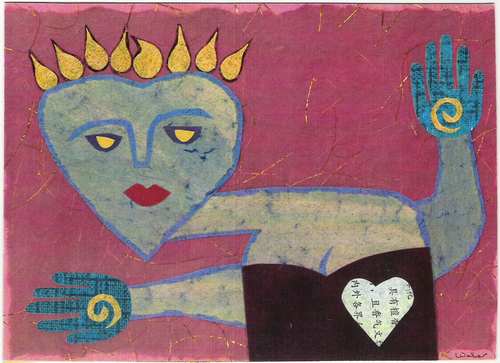
Recently I was talking with a friend about creative cycles, and how Spring is often one of my creative times. Ideas and projects multiply exponentially. She mentioned that she always thought of those times as when she was on fire, and asked if I felt that as well.
I had a bit of a wander around thinking about that. There are, of course, times when I feel on fire, but I’m certainly not a fiery person. In the 9-Star Ki Chinese system of organizing principles I’m Yang Wood, Water, and Yin Metal. In the Indian Ayurvedic system I am Kaffa. As someone once told me, I’m “like the slow, clear, well-spaced tones of the sitar; unhurried and with the understanding there is enough time.” I tend to think of myself as quite watery – intuitive and flowing. My astrological natal chart is filled with water – I’m a Cancer sun, and Scorpio moon for starters. And while I might readily admit I have a heart that’s afire, there’s very little else about me I might give that description to.
But I do know what my friend meant when she asked. When I’m on fire I feel very focused and clear, almost riveted to what I’m doing. I imagine every one of my cells is electrified, at attention, pouring its energy into the momentum, full-on in creation mode.
That reminded me once when I had a hand reading, I was told I had fire hands. While that term has everything to do with hand shape, it made me consider energetic possibilities as well. What might I create with hands of fire?

What about you? When are you on fire? Do you think of yourself as more fiery, watery, airy, or earthy? Are you a devotee of hearth and home? Do tell – you know I love to hear.
Fascinating and educational post, Deborah. Always a good read.
Thanks, Lisa.
Loved the mythology. I didn’t know that’s what a short match is called. Now to confuse everyone… LOL.
Ronel visiting for A-Z Challenge Vain Faery Godmother & My Languishing TBR: V #AtoZChallenge2025 #Books #Bookreview
LOL – go for it, Ronel!
Late to your posts. As a lover of words I’ll be back.
It’s always a delight to meet a kindred logophile. Thanks for stopping by, Jill.
Hari Om
Interesting – in the UK, Swan Vesta is a brand name for one lot of matches, so I didn’t realise it was also the generic name for what they were (although I did know it was in honour of the goddess).
Today is my b’day – very much Taurean, though moon and rising sign is Sagittarius. The earth and air struggle with each other a bit – which tends to create fires, both necessary and unnecessary! YAM xx
Happy Birthday, Yamini – may this next trip around the sun be filled with great joy!
You made me laugh – necessary and unnecessary fires. Indeed.
Great post! I was area of Hestia and Vesta, but not of a word ‘vesta’.
I love the idea of hearth and home, since I’m an introvert. Because of that, it took me a long time to come to grips with the fact that I don’t enjoy the practices of hearth and home.
I’ve always felt more earthy than fiery.
I think we share that, Joy – I’m introverted, leaning towards reclusive. So my home is definitely a sanctuary. But “domestic skills” are not something I enjoy placing a lot of time or energy on.
Aaw, I remember Swan Vestas. I had a matchbox collection with some lovely boxes in it, but think I gave it to my sister. As a child I used to like making “furniture” by fitting the boxes like together.
It was quite late when I learnt that Vesta was the Roman goddess of hearth and home. I had heard the term “vestal virgins” for years without even wondering where it came from.
To your question about our own mix of fire and the other elements: My words are fiery and so, sometimes, are my actions, but in my heart of hearts, I would often prefer to withdraw and consider it all from a distance, or in books. I like fire, but I also like it to be contained. As in when they say that someone holds a candle for another person–they don’t set things on fire with the candle! Although I love home, I’m not much of a homemaker–mostly due to laziness.
Loving your A-to-Z and will be sorry when it’s over.
Match box furniture – I love that. I’ve always loved little boxes to stick little treasures in. I grew up and discovered apothecary chests and the delight of lots of small drawers.
I like your distinction about candle fire.
Interesting post as usual!
Thanks, Brenda.
I’d never heard of this word and am so happy to learn it! Spring is a time of creativity for me, too. The nice weather and blooming flowers and greenery really inspire me.
– Allison
https://lightningflashwriting.blogspot.com/
Watery all the way here! And it made me smile — being a “devotee of hearth and home” sounds a lot like being a devoted fika lover to me. Cozy moments are everything!
PS: Not familiar with the term “fika”? It’s the Swedish way of sharing coffee and pastry (think “cinnamon bun”) with friends. Just learned about it last week in Stockholm!
I’m on board – consider me a very dedicated fika lover. 🙂
Although I say spring isn’t my favorite season, I too feel more creative when the world is budding and growing around me. Perhaps I’m also part of that ecosystem? Matchbooks and boxes were so artistic in the past. I love that cat one!
Who knew there could be so much to a match! Another fascinating post, Deborah, and in answer to your question, I don’t really believe in the Zodiak but many of Pisces characteristics seem to fit, so I guess I think of myself as a water soul…
Thanks, Andrew. I’m not an astrologer, but I can see how you’re a Pisces match. 🙂